
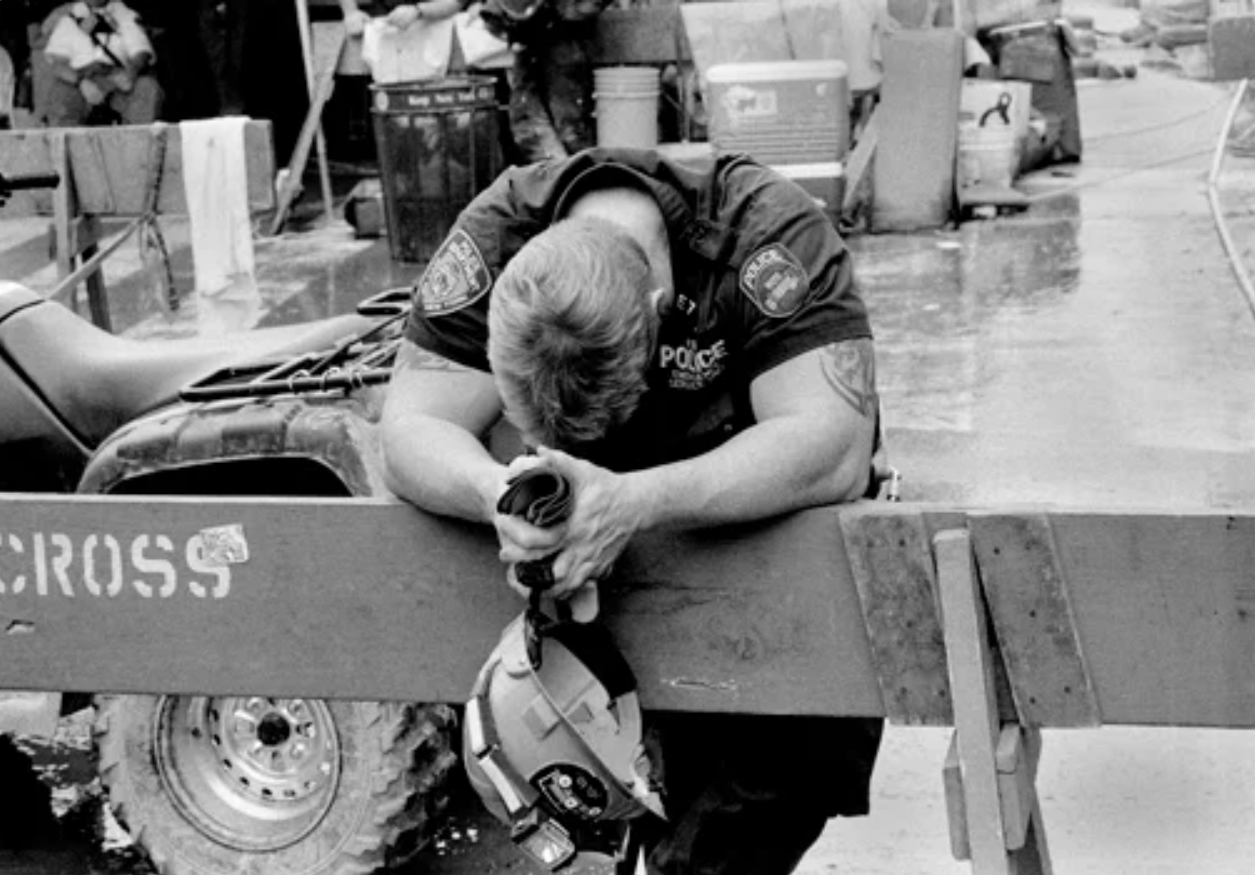
September 11, 2013 / CBS News, Botte, J. This photograph shows William “Bill” Fischer – an NYPD Emergency Services Unit officer – who was involved in the rescue of Port Authority Police Officer Sgt. John McLoughlin. McLoughlin was the last man pulled alive from the ruins of the World Trade Center—9/11 pictures taken by former NYPD detective John Botte.
Content warning: The following content contains 9/11 related details.
I was fundamentally relishing the privilege to participate in an illuminating educational juncture psychologists call a “post-doctorate,” which signifies the year after I completed my Ph.D. and was selecting a topic with auxiliary pedagogy and with vaster vigour with 9/11 first responders at none other than Bellevue Hospital, the most prehistoric hospital in the entire country and, by many markers, its own city, which accommodates a school, a homeless shelter and a jail, among a plethora of medical and mental health programs. This was from 2011-2012, a decade for me after the heartrending terrorist attack had permeated so much of my chosen home city, still devastated from the medical impact of breathing the air that day forward at Ground Zero, not to mention the psychological impact of an inestimable toll of being haunted by those who were indeed traumatized. My research and clinical passions were once again deeply aligned, as I had written two impassioned papers in my laboratory on our 9/11 sample of survivors— signifying humans who survived escaping the World Trade Center, also known as the “Towers,” and lived to tell the tale with my graduate school advisor, renowned resilience and trauma expert George Bonanno’s longitudinal samples taken before and after 9/11. When I applied for this opportunity, I knew in my heart of hearts that I would be marrying my investigative and clinical co-passions. What better way to live out loud my poignant trauma research than to work with first responders?
I both consulted with and dispensed therapeutic medicine to police officers and other 9/11 first responders, and I facilitated groups because, although first responders include a wide range of classifications, many at the Bellevue program at the World Trade Center were New York Police Department officers. I received rigorous scholarly and literary lessons on “Police Culture,” which I then presented to the program’s co-staffers. First and foremost, I define “culture” through a lens of social psychology as “social patterns of shared meaning.” In essence, it is a collective understanding of the way the world works, shared by members of a group and passed down from one generation to the next. (Introduction to Psychology, 15.1 Culture: Biswas-Diener, R; Thin, N and Sanders, L. 2019). Societies have several core components, including versatility, meaning culture and language can change and adapt. Sharing: Culture is the product of people sharing identities and passing them down to subsequent generations. Humans cooperate and share knowledge and skills with other members of their networks. Versatility: Culture can change and adapt. Accumulation: Cultural knowledge is cumulative. That is, information is thereby “stored.” This means that a culture’s collective learning grows across generations. Patterns: There are systematic and predictable ways of behavior or thinking across members of a culture.
Radically, police officers are the only members of society outside of the military in my country with a mandate to bear guns as part of their job, legally. “The right to bear arms” is indeed the Second Amendment in my nation and thus embedded in the deluge of meaning of my country’s founding. Now envision the tremendous burden of responsibility that must accompany such a role of having to make a life-threatening and life-ending decision in a millisecond of heated rivalry, let alone when we consider the power of racism or patriarchy impacting such decisions unconsciously. As such, the job is extraordinarily dangerous and might lead to social isolation. Many of the fellow police officers that I came to know profoundly identified as “Tough Guys” who perceived and experienced danger, along with Social Isolation. They are also mandated to use coercive authority: Police have a unique “license to threaten drastic harm to others” (Muir, 77, p. 37) through arrest, use of deadly force, and the responsibility to make life-altering decisions efficiently and to live with them.
Danger and repeated exposure to gruesome crime are simply part of the job description, which may lead to potential posttraumatic stress responses. How do they cope with chronic exposure to grisly crime scenes? Sometimes, with what Paoline (2003) described as “suspicion,” “maintaining the edge,” and also a “crimefighter image,” which signifies a fundamentally moral career. Tough guys and social isolation follow the heartbreaking guideline that “Remember that there are people out there who will kill you and go home and sleep like a baby.“ (Woody, 2005, p. 527). Of course, such truisms sink into your soul and may engender coping skills like such as “displacement,” as Miller indicates: an unconscious defense mechanism whereby a person redirects strong emotions or aggression from the actual source of their distress onto a safer, less threatening target. This could heartbreakingly render either self -blame or anger management issues. According to Miller, action-oriented coping (Miller, 2005) predominates. Inordinate levels of alcohol consumption (Violante, 2004) are another dark source of temptation for sorrow-drowning.
Awareness of danger induces vibrations of separation from the public (among other components). Insular “cop culture” is also known as “the job” (Blau, 1994). An “Insular Cop Culture” means that there is hauntingly predominant separation from family and encouraged group cohesion, especially among police officers in training, social isolation, and by means of coercive authority. (Woody, 2005, p. 527) Through exposure over time, recruits tend to operate the most vulnerable senses of self. During police officers’ literal indoctrination into “Cop Culture” at a“Police Academy,” which serves to impassionately educate young recruits who have terminated the exams. A “Blue Code of Silence” among police officers, who wear their profoundest, most vibrant shades of blue uniforms across the States and nationally, predominates as an unwritten rule among police officers that discourages them from reporting mistakes, misconduct, or crimes committed by fellow officers. Cop Culture and cohesion lead to brotherhood among police and a feeling of family. The “Us vs. Them Mentality” is an insular mentality whereby cohesion is privileged and isolated or judged by the public, making self-protection and in-group fantasies the priority of everyone. Retaliation against others was profound.
An ambivalent relationship with the public that they are fervently protecting from crime predominates the police force, which may viciously oscillate between two polar dialects. Are they heroes, as we wish to remember when gazing at befallen heroes during 9/11? Or perpetrators of police brutality, like in the George Floyd case, whereby an unarmed black man was brutally murdered by four police officers, simply due to the minor offense of being accused of attempting to use a counterfeit twenty-dollar bill in a local convenience store? This father, husband, and human was brutally murdered by a police officer who knelt on his neck for 9 minutes, as the man screamed, “I can’t breathe!” This was in Minneapolis, on May 25, 2020, and an unofficial protest cry that fostered the ‘Black Lives Matter Movement.” This was approximately one decade and a half, one decade subsequent to my vibrating tenure at Bellevue. Nevertheless, my country was founded upon an ambivalent relationship between the public and the police.
In facilitating groups, I witnessed the effervescence of the “Cop Culture” and the iterations thereof. Predominantly, when I began, I was asking the police officers, as I was confused about why so many of them were suffering from trauma symptoms when so many of them had been exposed to an unknowable number and nature of haunting crime scenes prior to Ground Zero and the WTC collapsing into clouds of disintegrated dust. What about 9/11 and their experiences was so utterly destabilizing?
It was one of the young male police officers who had an exceptionally high IQ who taught me about a truism of 9/11 police officers that led to my precipitous compassionate comprehension. We all unconsciously emanate knowing. A defense that was shattered that day that had served them throughout their tenures as police officers, was the truism, “There are no innocent victims!” This had served as a rally cry for so many officers throughout their careers and may have been, along with camaraderie with fellow officers, one of the few motivators to get them out of bed each day, cultivating disdain for the crime victims. Believing such a soul-shattering truism of your job was indeed undone that day when so many civilians and police alike who simply made the radical mistake of going to work undid the soul-synching truism that shatters your sense of self.
I found that many officers found their most traumatic moment not, in fact, what you would imagine. One of my NYPD detectives shared that his most haunting trauma was not indeed when the planes were hit, nor any graphic moments you would theorize. It was when he, perceived by police officers as ’a Tough Guy,’ laughed at how attractive the victim’s living wife’s body was. A boy’s club was erected and undone in a single moment of horror. How could he have laughed at her body? In a moment, he was indeed part of years of patriarchy that was undone precipitously, along with the horror of the person he had become to merely survive. Such a person was awakened by the truism being challenged, which then brought him back to all of the similar moments he had survived and witnessed.
Defenses sometimes melt and other times shatter into glass shards like broken windows. May you cultivate compassion for the police officers like I did that day. Most of them are young and underprepared. I do witness both sides of the ambivalent relationship between police officers and the public that my country was founded on.